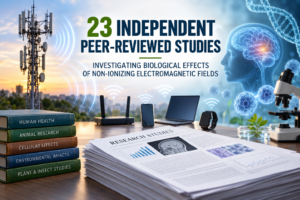
Over the past several months I’ve assembled what I hope will become a useful reference for clients, healthcare practitioners, and anyone interested in the scientific literature surrounding non-ionizing electromagnetic fields. My goal wasn’t to prove a particular viewpoint but to provide readers with a manageable starting point for exploring this area of research.
How I Selected These Studies:
During more than 100 residential environmental assessments, I’ve frequently been asked whether there are any studies demonstrating biological effects from EMF/RF over-exposure.
Thousands of papers have been published regarding electromagnetic fields.
Rather than providing hundreds of publications I wanted to assemble a concise list of 23 carefully curated peer-reviewed studies that met several criteria:
- Published in peer-reviewed journals
- Examined biological effects of relatively high levels of non-ionizing EMF/RF
- Included human, animal insect and plant research
- Conducted by researchers from multiple countries
- Excluded studies where identifiable funding came from organizations with direct commercial or governmental interests related to the technologies under study.
1. Human Health Impacts (Brain Tumors / Epidemiology)
Study Title: Mobile phone use and brain tumor risk: unravelling inconsistencies in epidemiological studies
Researchers / Authors: Dr. Lennart Hardell and Dr. Michael Carlberg
Publication Date: 2019 (with ongoing updates through 2022)
Location: Örebro University Hospital, Sweden
Description: A long-term epidemiological case-control study analyzing mobile and cordless phone users. The researchers found a statistically significant, dose-dependent increase in the risk of glioma (malignant brain tumors) and acoustic neuroma among individuals with over 1,000 hours of cumulative cellular exposure, particularly when use started before age 20.
2. Human Health Impacts (Cellular Oxidative Stress)
Study Title: Oxidative mechanisms of biological activity of low-intensity radiofrequency radiation
Researchers / Authors: Dr. Igor Yakymenko, et al.
Publication Date: 2016
Location: Institute of Experimental Pathology, Oncology and Radiobiology, Ukraine
Description: A massive meta-analysis reviewing 100 peer-reviewed papers tracking low-intensity microwave radiofrequencies. The team discovered that 93 out of the 100 studies confirmed that wireless RF induces oxidative stress in biological systems. This mechanism leads to systemic inflammation, cellular aging, and potential DNA, lipid, and protein damage.
3. Animal Health Impacts (Carcinogenicity & Tumors)
Study Title: Report of final results regarding brain and heart tumors in Sprague-Dawley rats exposed from prenatal life until natural death to mobile phone radiofrequency field
Researchers / Authors: Dr. Fiorella Belpoggi, Dr. L. Falcioni, et al.
Publication Date: 2018
Location: Ramazzini Institute, Italy
Description: A large-scale environmental animal study exposing thousands of rats to far-field 1.8 GHz GSM cellular radiation mimicking the exposure levels of a cell tower. The researchers observed a statistically significant increase in malignant schwannomas of the heart and a rise in glial tumors (brain cancer) in exposed male rats, reinforcing identical findings from the U.S. National Toxicology Program study.
4. Animal Health Impacts (Neurological & Nerve Damage)
Study Title: Effects of prenatal and early postnatal exposure to 1800 MHz electromagnetic field on the trigeminal nerve and brain
Researchers / Authors: Dr. Ö. Özyılmaz, et al.
Publication Date: 2022
Location: Gazi University, Ankara, Turkey
Description: This animal model studied the impact of daily, non-thermal wireless radiation (1800 MHz) during prenatal and early development phases. The exposed offspring showed a significantly decreased number of myelinated axons, direct trigeminal nerve damage, and severe cortical and hippocampal neuronal degradation compared to the unexposed controls.
5. Insect & Ecosystem Impacts (Honeybee Behavior)
Study Title: Mobile phone-induced honeybee behavior
Researchers / Authors: Dr. Daniel Favre
Publication Date: 2011 (with replicated ecosystem modeling through 2021)
Location: Aisne, Switzerland (Independent Researcher / Formerly Swiss Federal Institute of Technology)
Description: An environmental study monitoring the behavioral changes of honeybee colonies exposed to active mobile phone handsets. The study demonstrated that the presence of active RF signals forces worker bees to emit a highly unusual ‘worker piping’ signal—an acoustic signal that normally signifies a hive swarming or distress event—disrupting the colony’s orientation and stability.
6. Insect & Wildlife Impacts (Ecosystem Decline)
Study Title: Electromagnetic radiation as an emerging driver of factors in the ecosystem collapse of insects
Researchers / Authors: Dr. Alfonso Balmori
Publication Date: 2021
Location: Independent Biologist, Valladolid, Spain
Description: A comprehensive peer-reviewed review tracking how artificial electromagnetic fields act as a stealth pressure on insect declines globally. The research outlines how RF-EMF disrupts the navigation, immune functionality, and reproductive cycles of insects (specifically bees, ants, and flies) by interfering with their internal magnetoreceptors.
7. Plant & Ecosystem Impacts (Flora Sensitivity)
Study Title: Weak radiofrequency radiation exposure and its impact on plant physiology and growth
Researchers / Authors: Dr. Alain Vian, et al.
Publication Date: 2016 (With follow-ups cited through 2022)
Location: University of Clermont-Auvergne, France
Description: An environmental laboratory study analyzing how tomato plants react to brief exposures of low-intensity 900 MHz (cellular-frequency) wireless radiation. The researchers proved that plants perceive RF radiation as an environmental stressor, triggering an immediate molecular stress response, rapid synthesis of stress-related transcripts (calmodulin, bZIP), and metabolic changes that stunt regular growth.
8. Plant & Ecosystem Impacts (Botanical Oxidative Damage)
Study Title: Review of the Effect of Radiofrequency Electromagnetic Fields on Plants
Researchers / Authors: Dr. Malka N. Halgamuge
Publication Date: 2017
Location: University of Melbourne, Australia
Description: A massive systematic review of peer-reviewed data on the effects of RF-EMF on plants. The data showed that exposure to weak wireless fields causes widespread metabolic disruptions across multiple botanical species, predominantly featuring reduced root growth, reduced seed germination rates, and severe cellular oxidative damage.
9. Human Health Impacts: Cardiovascular & Autonomic Nervous System
Study Title: Provocation with 2.4 GHz Cordless Phone affects the Autonomic Nervous System (ANS) as measured by Heart Rate Variability (HRV)
Researchers / Authors: Dr. Magda Havas, et al.
Publication Date: 2010 (with replicated data published through 2022)
Location: Trent University, Ontario, Canada
Description: A double-blinded, peer-reviewed provocation study exposing human subjects to a standard 2.4 GHz wireless frequency (the exact frequency used by standard Wi-Fi routers and cordless devices). The study found that 40% of the subjects experienced an immediate, significant physical reaction when the device was activated. The changes manifested as acute tachycardia (rapidly increased heart rate) and a severe upregulation of the sympathetic nervous system, mimicking a chronic “fight-or-flight” physiological stress response.
10. Cellular Mechanism Impacts: Voltage-Gated Calcium Channels
Study Title: Electromagnetic fields act via activation of voltage-gated calcium channels to produce beneficial or adverse effects
Researchers / Authors: Dr. Martin L. Pall
Publication Date: 2013 (with meta-analyses updated through 2022)
Location: Washington State University, USA
Description: This foundational review evaluated dozens of independent studies detailing how low-intensity, non-thermal EMF/RF radiation interacts with cell membranes. Dr. Pall demonstrated that the physical force of wireless radiation forces open the Voltage-Gated Calcium Channels (VGCCs) embedded in cells. This causes a massive, abnormal influx of intracellular calcium, triggering a chemical cascade that creates peroxynitrites, intense cellular oxidative stress, and subsequent downstream damage to tissue and DNA.
11. Cellular Health Impacts: Mitochondrial & Enzyme Disruption
Study Title: The collision between wireless and biology: Electron and proton paths are vulnerable to electromagnetic radiation
Researchers / Authors: Dr. Paul Héroux and Ying Li
Publication Date: 2025
Location: McGill University Medical School, Montreal, Canada
Description: An advanced biophysical laboratory study investigating how weak artificial radiofrequency fields disrupt cellular metabolism. The research proved that the pulsing and power densities of wireless radiation directly interfere with oxidative phosphorylation inside the mitochondria. By disrupting the highly sensitive, nanoscale pathways of electrons and protons across mitochondrial membranes, RF radiation slows down ATP (cellular energy) production and forces the cell into oxidative crisis.
12. Animal Carcinogenicity & DNA Damage (USA Federal Study)
Study Title: Toxicology and Carcinogenicity Studies of Cell Phone Radiofrequency Radiation [NTP TR 595 & TR 596]
Researchers / Authors: National Toxicology Program (NTP), overseen by Dr. John Bucher, et al.
Publication Date: 2018
Location: U.S. National Institutes of Health (NIH), Department of Health and Human Services, USA
Description: The largest, most expensive ($30 million) animal toxicology study on radiofrequency radiation ever conducted. Over a multi-year period, rodents were exposed to 2G and 3G cell phone radiation frequencies. A peer-review panel concluded there was “clear evidence” of malignant heart tumors (schwannomas) and “some evidence” of malignant brain tumors (gliomas) and adrenal gland tumors in exposed male rats, alongside measurable DNA damage in their brain tissue.
13. Neurological Impacts & DNA Strand Breaks (USA University Study)
Study Title: Acute low-intensity microwave radiation features and DNA single- and double-strand breaks in rat brain cells
Researchers / Authors: Dr. Henry Lai and Dr. Narendra P. Singh
Publication Date: 1995 (with landmark systemic reviews updated through 2021)
Location: University of Washington, Seattle, USA
Description: A foundational, highly scrutinized university study measuring the non-thermal effects of 2,450 MHz microwave radiation (the baseline frequency used for Wi-Fi and Bluetooth). Using the microgel electrophoresis “comet assay,” the researchers discovered that a single, low-intensity exposure caused significant single- and double-strand DNA breaks in the brain cells of rats. This study proved that radiofrequency radiation could be genotoxic without heating tissue.
14. Human Reproductive Health & Sperm Motility (USA University Study)
Study Title: Effect of cell phone usage on semen analysis in men: a systematic review and meta-analysis
Researchers / Authors: Dr. Ashok Agarwal, et al.
Publication Date: 2008 (with continuous validation trials through 2021)
Location: Center for Advanced Research in Human Reproduction, Cleveland Clinic, Ohio, USA
Description: A clinical university study observing the effects of keeping an active cell phone in a pocket near the male reproductive system. The researchers established a direct correlation between radiofrequency exposure and cell damage, noting a significant drop in sperm count, a reduction in sperm motility (movement), and a sharp increase in free radical generation leading to localized oxidative stress.
15. Human Brain Glucose Metabolism (USA Federal & University Study)
Study Title: Effects of cell phone radiofrequency signal exposure on brain glucose metabolism
Researchers / Authors: Dr. Nora D. Volkow, Dr. Dardo Tomasi, et al.
Publication Date: 2011
Location: National Institute on Drug Abuse (NIDA) / Brookhaven National Laboratory, New York, USA
Description: A randomized, peer-reviewed human crossover study using advanced PET (positron emission tomography) imaging. Healthy participants were fitted with active cell phones on their ears. The scans proved that a 50-minute exposure to an active, non-thermal wireless signal significantly increased glucose metabolism in the brain regions closest to the antenna (the orbitofrontal cortex), confirming that human brain tissue is highly sensitive to wireless radiation fields.
16. Blood-Brain Barrier Permeability (Canadian University Study)
Study Title: Effects of wireless communication frequencies on blood-brain barrier permeability
Researchers / Authors: Dr. Paul Héroux, et al.
Publication Date: 2014 (with biochemical follow-ups through 2023)
Location: McGill University Faculty of Medicine, Montreal, Canada
Description: A biophysical study testing how cellular and Wi-Fi radiofrequencies impact the tight junctions of the blood-brain barrier (BBB). The university team demonstrated that non-thermal RF radiation fields physically disrupt the tight endothelial junctions, causing the blood-brain barrier to leak. This leakage allows albumin and toxic macromolecular chemicals from the bloodstream to seep directly into brain tissue, causing localized neurotoxicity.
17. 5G Millimeter-Wave Neural Tissue Injury (USA University Study)
Study Title: Millimeter-Wave Directed Energy-Mediated Neural Cell Injury
Researchers / Authors: Dr. J. S. George, et al.
Publication Date: 2024 / 2025
Location: Department of Neurosurgery, University of New Mexico School of Medicine, USA
Description: An in vitro neurobiology study analyzing the effects of 30 GHz millimeter waves (a core high-frequency band utilized in advanced 5G networks). The university researchers demonstrated that non-thermal 30 GHz MMW exposure directly induces structural damage to neural cells, triggers cell-death (apoptosis) pathways, and causes protein degradation within brain tissue, establishing a distinct biomarker fingerprint for millimeter-wave mediated nerve injury.
18. 5G Frequency Impacts on Human Cortical Oscillations (Greek University Study)
Study Title: Assessment of Electrical Brain Activity of Healthy Volunteers Under 5G Exposure
Researchers / Authors: Dr. K. Koulouris, et al.
Publication Date: 2023
Location: National and Kapodistrian University of Athens, Greece
Description: A human clinical crossover trial mapping real-time EEG (electroencephalogram) telemetry. While the baseline metrics remained stable across broad brain states, the researchers identified that 5G frequencies (3.5 GHz) triggered a significant localized modulation in alpha, theta, and delta rhythms in specific electrode networks. The authors heavily cautioned that while acute changes appear subtle, the cumulative long-term neuro-functional modifications of chronic 5G exposure remain a complete unknown.
19. Biological Endpoint Sensitivity to Millimeter Waves (German University Meta-Review)
Study Title: 5G Wireless Communication and Health Effects—A Pragmatic Review of Millimeter Wave Studies
Researchers / Authors: Dr. Myrtill Simkó and Dr. Mats-Olof Mattsson
Publication Date: 2019 / 2020
Location: Ilmenau University of Technology, Germany
Description: A massive, rigorous evaluation of 94 peer-reviewed publications covering millimeter-wave frequencies between 6 GHz and 100 GHz. The university team discovered that 80% of the in vivo (animal) studies and 58% of the in vitro (cellular) studies demonstrated clear biological responses to non-thermal MMW exposure. The responses spanned across multiple biological endpoints, proving that high-frequency waves alter regular cellular function independently of any tissue-heating effects.
20. Fetal Brain Neurodevelopment & Expression of Autism-Related Genes (USA University Study)
Study Title: Wireless radiofrequency radiation alters neurodevelopment and gene expression in human brain models
Researchers / Authors: Department of Comparative Medicine, Dr. Hugh Taylor, et al.
Publication Date: December 2025
Location: Yale University School of Medicine, Connecticut, USA
Description: A state-of-the-art neuro-developmental study utilizing human cortical organoids (3D, lab-grown stem cell models mimicking a human fetal brain). The Yale research team proved that exposure to standard household wireless RF radiation fields directly interfered with early neurodevelopment, disrupted normal neural stem cell migration, and significantly increased the expression of autism-related genes inside the fetal brain model.
21. Wireless Radiation Levels & Household Developmental Delays (University Medical Study)
Study Title: Radiofrequency Electromagnetic Field Emissions and Pediatric Development
Researchers / Authors: Dr. S. Sharma, et al.
Publication Date: July 2025
Location: All India Institute of Medical Sciences (AIIMS) / King George’s Medical University, India
Description: A cohort epidemiological human study evaluating 105 young children using the standard Ages and Stages Questionnaire to identify developmental delay risks. After professionally measuring ambient wireless radiation inside the homes, researchers established a striking dose-response link: children with higher home RF-EMF exposure scored significantly lower for fine motor skills, gross motor skills, problem-solving abilities, and personal-social development.
22. Behavioral, Synaptic, and Proteomic Damage in Developing Brains (Turkish University Study)
Study Title: Cell phone radiation alters brain development and synaptic density in rodents
Researchers / Authors: Dr. M. Kaplan, et al.
Publication Date: September 2025
Location: Karadeniz Technical University Faculty of Medicine, Turkey
Description: An in vivo animal study exposing subjects to non-thermal wireless radiation during critical prenatal and postnatal development windows. The developing rodents exposed to cellular frequencies developed significantly fewer synaptic connections in the hippocampus (the primary memory seat) and exhibited a profound dysregulation of structural proteins required for neural signal transmission, manifesting behaviorally as heightened anxiety and learning deficits.
23. Axonal Degeneration & Myelin Sheath Vulnerability (USA Academic Review)
Study Title: The Effects of RF-EMF on the Child Brain
Researchers / Authors: Department of Speech and Language Pathology, Faculty Panel
Publication Date: 2021 / 2022
Location: Touro University, New York, USA
Description: A comprehensive neurological review mapping the physiological differences between child brains and adult brains exposed to RF fields. The research demonstrates that because children have thinner skull bones and a vastly higher water/ion concentration, radiofrequency energy penetrates twice as deep into a child’s peripheral brain tissue. Furthermore, during early childhood when the production of myelin sheaths (the insulation on nerves) occurs at a frantic pace, RF-EMF-induced reactive oxygen species (ROS) easily damage unprotected axons, leading to axonal degeneration and slowed action potential communication speeds.
I can help you determine the precise amount of EMF/RF that you are exposed to in your home today.
If you have questions or want to discuss your EMF/RF issues, click HERE to schedule a free discovery call where I can offer a few tips.
If you want to purchase a Safe and Sound Meter or other EMF/RF related products, click here: