 How Can EMF/RF Radiation Affect a Cell’s Electrical System?
In [Part 1 of We Are Electrical Beings], I wrote about something that still fascinates me: everything about us depends on electricity.
Our brains, hearts, muscles, nerves and even the individual cells that make up our bodies depend on extraordinarily small electrical signals.
Then, in [Part 2 of We Are Electrical Beings], I looked at the other side of the equation: while our biology is still electrical, the electrical environment surrounding us has changed dramatically.
That leads to the question I want to explore in Part 3:
What actually happens when the electrical system of a living cell is exposed to externally generated low frequency electric or magnetic fields (EMF) and radiofrequency (RF) electromagnetic fields?
This is where my engineering background and my work in Building Biology come together in a particularly interesting way.
Before we can answer that question, though, we need to understand just how electrical a single human cell really is.
Every Cell in Your Body Is a Tiny Electrical System
The human body contains tens of trillions of living cells.
Every one of those cells maintains an electrical voltage across its outer membrane.
Instead of electrons flowing through a copper wire, cellular electricity involves charged atoms called ions—particularly sodium, potassium, calcium and chloride—moving across cell membranes.
The electrical difference between the inside and outside of a cell is called its membrane potential.
I sometimes think of each cell as having its own tiny rechargeable battery.
The cell membrane acts as an insulator separating electrical charges. Specialized proteins called ion channels control which charged particles can cross the membrane. And the sodium-potassium pump continuously moves sodium out of the cell and potassium into it, helping maintain the electrical difference between the inside and outside.
All of this requires energy.
And it is happening inside you right now, in trillions of cells, whether you are thinking about it or not.
Some Cells Send Electrical Pulses. Others Use Electricity More Quietly.
We usually associate bioelectricity with the brain, nervous system and heart.
That’s understandable.
Neurons and muscle cells are known as excitable cells. A neuron at rest typically maintains a negative voltage across its membrane. When properly stimulated, ion channels open and charged ions rapidly move across the membrane.
The voltage suddenly changes.
That change—an action potential—allows a nerve impulse to travel.
Similar electrical processes allow muscles to contract and help coordinate the rhythmic beating of the heart.
But here’s the part I find especially interesting:
Cells don’t have to be neurons or muscle cells to use electricity.
Skin, bone, liver and many other so-called non-excitable cells also maintain membrane potentials and use changes in their electrical state as part of normal biological signaling.
Bioelectric signaling has been studied in processes including development, cell migration, tissue repair and cell division.
So, when I say that we are electrical beings, I’m not using the phrase metaphorically.
Electricity is part of the basic operating system of life!
Now Add EMF/RF to the Picture
Our cells evolved in an environment that has always contained naturally occurring electromagnetic fields (light, the earth’s magnetic field, etc.).
What has changed is the amount and complexity of man-made electromagnetic energy surrounding us.
Wi-Fi routers, cell phones, cordless phones, Bluetooth devices, smart appliances, wireless security systems, smart meters, cell towers and countless other technologies now use radiofrequency electromagnetic fields to communicate. The low frequency (50/60 Hz) electricity we use 24/7 has been around for well over a century!
The photons associated with EMF/RF radiation do not carry enough energy individually to ionize atoms in the way that X-rays and gamma rays can.
(That is why RF is classified as non-ionizing radiation).
But “non-ionizing” should not automatically be interpreted to mean “biologically inert”!
Peer-reviewed research has shown that man-made electromagnetic radiation can interact with biological systems through mechanisms that do not require ionization or significant tissue heating.
And one mechanism brings us right back to the electrical membrane surrounding the cell.
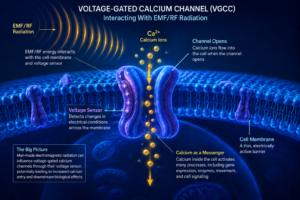
Voltage-Gated Calcium Channels: The EMF/RF Connection
Embedded in cell membranes are proteins called voltage-gated calcium channels, or VGCCs.
Think of them as microscopic gates.
They are designed to respond to changes in electrical conditions across the cell membrane. When they open, calcium ions can enter the cell.
Calcium isn’t merely something that builds bones. Inside a cell, calcium is an extraordinarily important signaling molecule involved in many biological processes.
Researcher Martin Pall and others have shown that electromagnetic fields can affect the voltage-sensing portions of these channels, causing VGCCs to open and allowing excessive calcium to enter cells.
That is important because too much intracellular calcium can initiate a cascade of downstream effects, including increased production of reactive oxygen species and oxidative stress.
Other EMF/RF Interactions with Cell Membranes
VGCCs are not the only mechanism researchers have explored.
The cell membrane is an extraordinarily complex structure made of lipids, proteins, charged molecules, water and electrically active ion channels.
Research has shown that man-made electromagnetic radiation can influence membrane properties, ion transport, calcium signaling and other electrical or electrochemical processes.
There are also models involving rectification—that biological structures can convert or respond to portions of an oscillating electromagnetic signal—and theories involving resonant or coherent behavior within biological structures.
Know this!
- Frequency matters.
- Intensity matters.
- Duration matters.
- Modulation matters.
- Distance from the source of man-made EMF & RF radiation matters enormously.
I do not fear technology!
In fact, I use technology. My previous careers depended heavily on it.
And as an engineer, I certainly understand the enormous benefits it has brought us.
I also believe in taking simple, practical steps to reduce exposures that aren’t necessary.
It’s prudent risk management.
At the heart of Building Biology there is the Precautionary Principle!
What is the cost to our health if we wait instead of taking practical steps now to reduce a potentially harmful exposure? When an exposure is unnecessary, when reducing it has little or no downside, and when there is legitimate scientific evidence about its biological effects, reducing that exposure is not an extreme response. It is a sensible application of precaution.
This is especially true because EMF/RF exposure is one of the easiest environmental stressors to reduce once you know where it is coming from.
You don’t have to eliminate EMF/RF entirely from your life.
You probably couldn’t even if you wanted to.
But, at the very least…
- You can turn off Wi-Fi when you don’t need it.
- You can avoid sleeping next to a wireless router or better yet, unplugging it at night.
- You can get rid of Wi-Fi altogether in your home by switching to a fully wired ethernet environment, completely eliminating high RF levels 24/7.
- You can keep a transmitting phone further away from your body, especially away from your ears.
- You can pay more attention to bedrooms, where you spend approximately one-third of your life.
Distance, duration and unnecessary exposure are things we can control.
This Is Why I Measure
One of the reasons I became a Building Biology practitioner is that I don’t want people to guess about their EMF/RF environment in their home or workplace.
I want to measure it.
I regularly enter homes or businesses where people have no idea what EMF/RF sources are present or how much exposure exists in the places where they sleep, work and spend most of their time.
Sometimes the source is obvious.
But often it isn’t.
And making relatively simple changes can substantially reduce exposure without giving up modern life.
My goal isn’t to make people afraid of electromagnetic fields.
It’s to help them understand their environment so they can make informed decisions about exposures they can control.
Because if the human body really is an electrical system—and at the cellular level, we know that it is—I believe it makes sense to pay attention to the electrical environment in which that system is being asked to function.
That is the approach I use in my own home, and it is the approach I recommend to my clients.
In the meantime, one fact remains beyond dispute.
We are electrical beings!
Perhaps it’s time we paid a little more attention to the electrical environment in which those billions of tiny electrical signals must function every moment of our lives.
I can help you determine the precise amount of EMF/RF that you are exposed to in your home today.
If you have questions or want to discuss your EMF/RF issues, click HERE to schedule a free discovery call where I can offer a few tips.
If you want to purchase a Safe and Sound Meter or other EMF/RF related products, click here:
https://healthyindoorconsultants.com/favorite-products
Follow me on Facebook and LinkedIn
References & Further Reading
Pall, M. L. (2013). Electromagnetic fields act via activation of voltage-gated calcium channels to produce beneficial or adverse effects. Journal of Cellular and Molecular Medicine.
Wood, A. W., Mate, R., & Karipidis, K. (2021). Radiofrequency Fields and Calcium Movements Into and Out of Cells. Radiation Research.
Additional peer-reviewed research has examined RF exposure, cellular signaling, oxidative stress, membrane function and other possible non-thermal biological effects.
Research remains ongoing.
- The BioInitiative Report ( https://bioinitiative.org/ )
- Environmental Health Trust Summary: https://tinyurl.com/2s38t84y